CP14 Explained: Your First IRS Bill, in Plain English
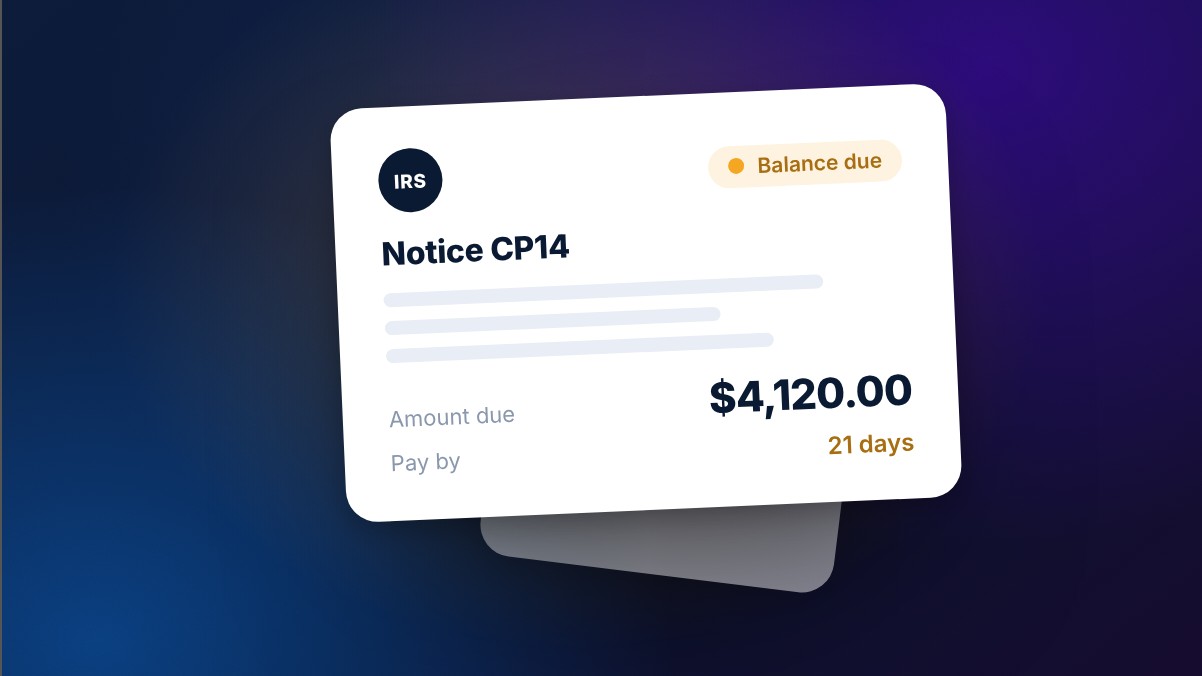
The CP14 is the most common letter the IRS sends, with millions mailed every year, and for many people it is the first sign that something on a return did not settle the way they expected. It is not a penalty notice and it is not a collection threat. It is a bill, and it is the cheapest, calmest moment you will ever have to deal with the balance behind it.
What a CP14 actually says
A CP14 tells you that a filed return posted with tax due and the IRS has not received full payment. It itemizes the tax year involved, the unpaid tax, the penalties assessed so far, the interest accrued through the notice date, and a pay-by date printed on the notice, typically about three weeks out. Pay by that date and the matter usually ends there.
Two meters are already running by the time the envelope arrives:
- The failure-to-pay penalty accrues at 0.5% of the unpaid tax per month (or partial month), and it can stack up to a maximum of 25% of the balance. If you are on an approved installment agreement, that monthly rate is cut in half, to 0.25%.
- Interest compounds daily from the return’s original due date, not from the notice date. The rate is set quarterly at the federal short-term rate plus 3 percentage points; through 2026 that has meant roughly 7% annually. Unlike penalties, interest generally cannot be removed unless it was charged in error.
That combination is why a balance that sits untouched grows faster than people expect, and why the same balance addressed at the CP14 stage costs meaningfully less than one addressed six months later.
Why you might get one even if you paid
CP14s regularly go to people who believe they already paid, and often they are right. The most common causes we see:
- A payment was applied to the wrong year or wrong account, especially estimated payments and payments made for one spouse under the other’s SSN.
- A payment crossed in the mail with the notice. The IRS generates CP14s on a cycle; a payment that posted days before the mailing may not be reflected.
- An estimated payment you claimed does not match IRS records, either because of a transposed amount or a payment that never cleared.
- The IRS adjusted the return during processing, for example correcting a math error or a credit, which created a balance you did not expect.
This is why the first step is not writing a check. It is checking what the IRS account for that year actually shows: what posted, when, and where it was applied. If a payment is misapplied, the fix is getting it moved, not paying twice.
The ladder a CP14 sits on
A CP14 is the first rung of a well-documented sequence. Leave it unaddressed and the follow-ups arrive on a fairly predictable cadence: a CP501 reminder, then a CP503, then a CP504, the Notice of Intent to Levy, which allows the IRS to seize state tax refunds and marks the account’s move into serious collections. After that comes the final notice, an LT11 or Letter 1058, which starts the 30-day clock on your hearing rights before wages and bank accounts can be levied, and a federal tax lien can be filed along the way.
Every step down that ladder means more penalties, more interest, fewer options, and more urgency. Nothing about the ladder is mysterious, and that is the point: the account shows each step as it happens, long before the next letter lands.
Your options at the CP14 stage
If the balance is correct and you can pay it, pay it, and the sequence stops. If you cannot pay in full, the IRS’s own programs are broad and, at this stage, easy to qualify for:
- Short-term payment plan: up to 180 days of time, no setup fee. Penalties and interest keep accruing, but collection activity pauses.
- Installment agreement: a monthly payment over as long as 72 months for individuals who owe $50,000 or less in combined tax, penalties, and interest and are current on filings. Setup runs $31 with direct debit (more for other payment methods, and waived entirely for taxpayers under 250% of the federal poverty level). The IRS itself reports that more than 90% of individual taxpayers qualify for a simplified plan.
- Penalty relief: if this is your first slip after a clean compliance history, first-time abatement can remove the failure-to-pay penalty. Reasonable-cause relief exists for genuine hardships. Interest attached to abated penalties comes off with them.
- If the balance is wrong: respond with the account history in hand, and get the payment traced or the adjustment corrected before agreeing to anything.
The one option with no upside is silence. The balance does not go stale, the meters do not stop, and the ladder does not pause.
Where TaxRock fits
Rocky reads a CP14 against your actual IRS account: whether the balance is real, what payments have posted and where they were applied, what penalties and interest make up the total, and what you are likely to qualify for. If a payment plan is the answer, TaxRock helps you file the installment agreement for a flat $249, without an expensive resolution firm. You can decode your notice free or see your payment plan options.
Sources
- IRS, Understanding your CP14 notice
- IRS, Failure to pay penalty
- IRS, Quarterly interest rates
- IRS, Penalty relief